Welcome to GCfit’s documentation!#
- Release:
2.0
- Date:
Jul 08, 2026
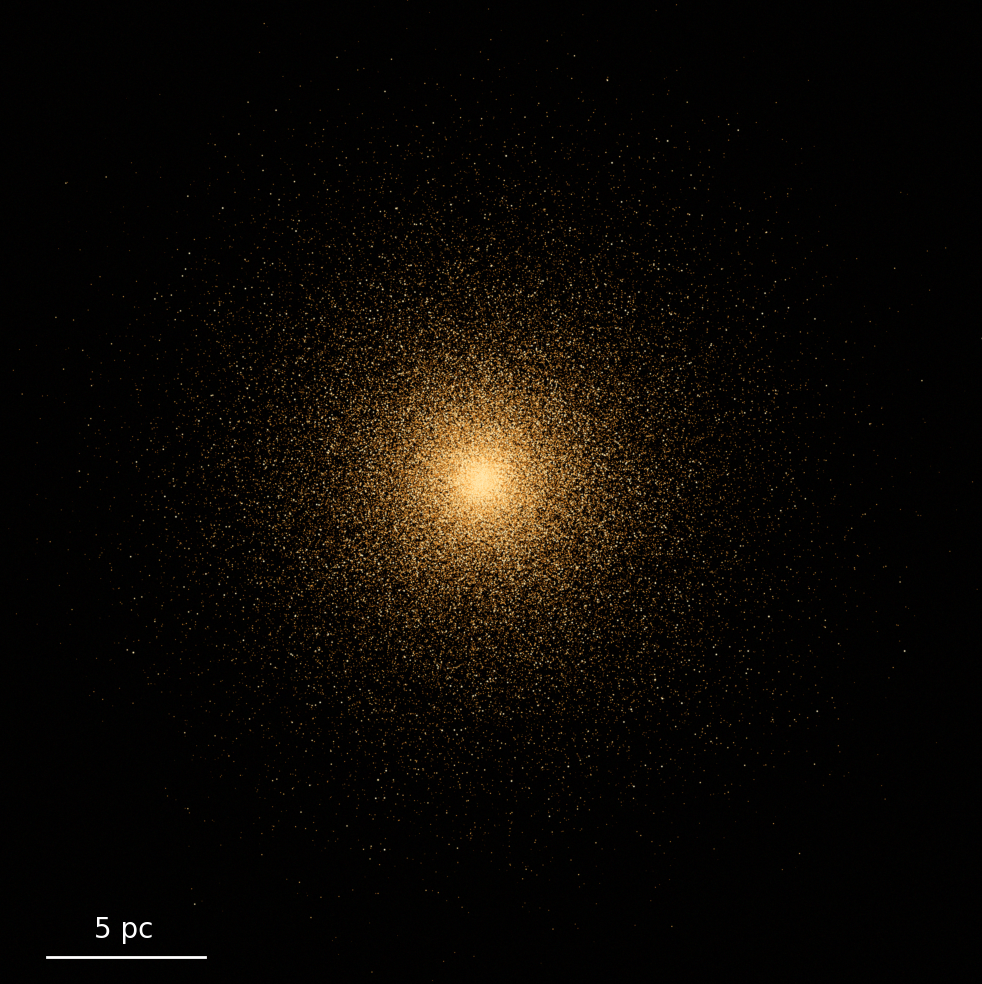
GCfit is a Python package enabling the creation and extension of distribution-function based lowered isothermal (LIMEPY) models, representing globular cluster (GC) systems, as well as the generalized fitting of these models to various observational GC data products, via a parallelized bayesian sampling suite.
Quick Start#
Globular cluster models are created using the
gcfit.Model class. The minimum
requirements are to supply a central potential (W0), a total mass (M), a
half-mass radius (rh), an age (age) and a metallicity (FeH).
>>> import gcfit
>>> model = gcfit.Model(6., 5e5, 3., age=12., FeH=-1.)
See Model for a list of accessible model attributes.
Certain characteristics, like age and metallicity, can be taken from real clusters using the corresponding observations data file:
>>> obs = gcfit.Observations('NGC104')
>>> model = gcfit.Model(6., 5e5, 3., observations=obs)
Single mass models are created in the same fashion, using the
SingleMassModel class:
>>> model = gcfit.SingleMassModel(6., 5e5, 3.)
Specific classes of models, such as King (1966) models, are created using the relevant constructors:
>>> model = gcfit.Model.king(6., 5e5, 3., age=12., FeH=-1.)
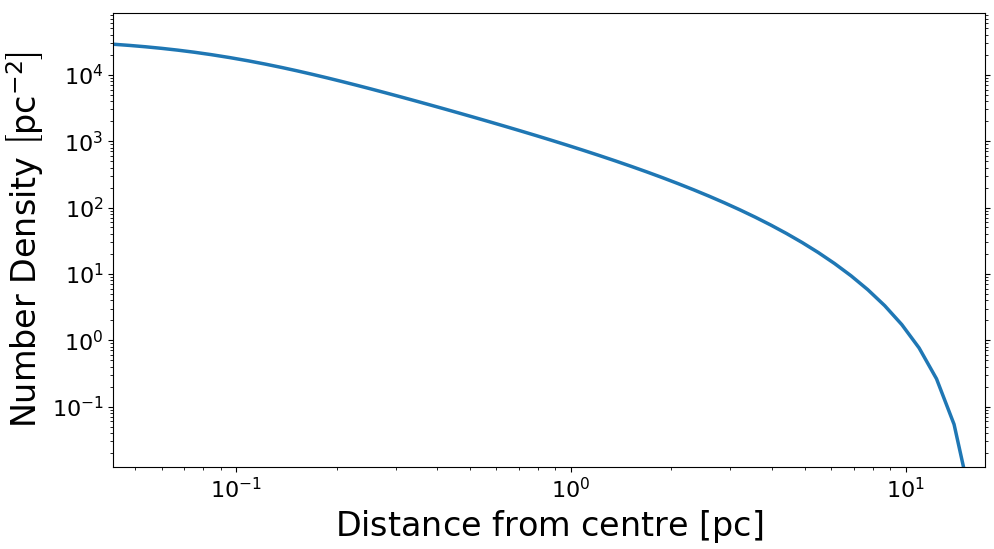
Easy visualizations of the models are done through the Analysis module:
>>> mviz = model.get_visualizer()
>>> mviz.plot_number_density(label_position='left')
Contents#
For more details on the models, fitting procedures, and the rest of the package, see the proceeding pages: